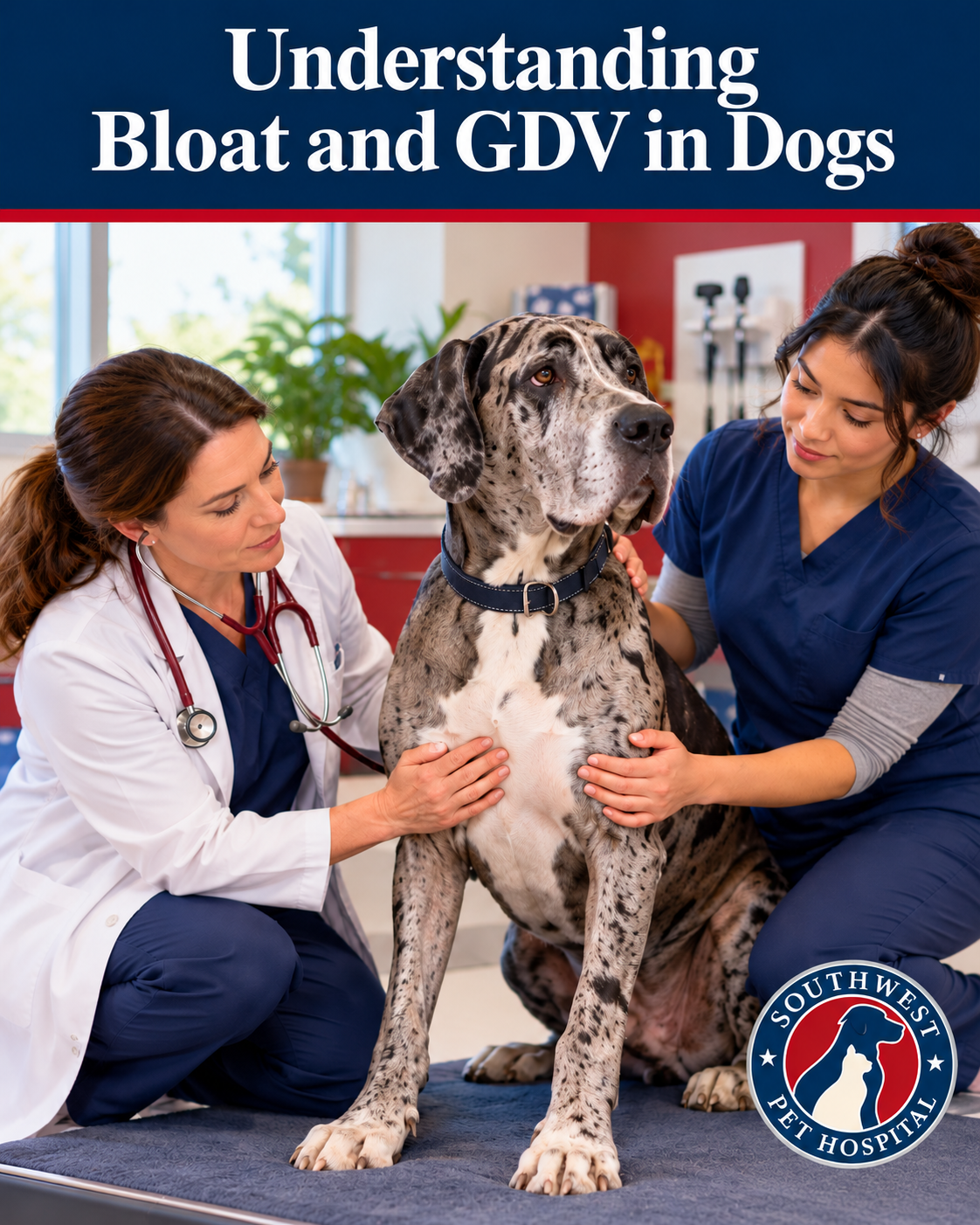
Gastric dilatation-volvulus, or GDV, is a life-threatening emergency. The stomach becomes distended and twists, trapping its contents and impairing circulation. Shock and tissue damage can develop rapidly. A dog with suspected GDV needs immediate veterinary care.
What to do if you suspect GDV
Call Southwest Pet Hospital immediately at 479-751-5601. If we are not immediately available, contact Animal Emergency and Specialty Center of Northwest Arkansas at 479-927-0007. Call the receiving hospital while arranging safe transport. Do not submit an online appointment request or wait for a callback.
Do not attempt home treatment or give food, water, or medication unless the receiving veterinarian directs you to do so.
Recognizing the warning signs
Possible signs include repeated attempts to vomit with little or nothing produced, restlessness, excessive drooling, panting, abdominal discomfort or enlargement, pale gums, weakness, or collapse. A dog may repeatedly lie down and stand up because it cannot get comfortable.
Do not wait for every sign or a dramatically swollen abdomen. Suspected GDV requires emergency evaluation even when the diagnosis is uncertain.
Bloat and GDV are related but different
Bloat refers to stomach distention. GDV includes twisting of the stomach, which compromises blood flow and requires emergency medical and surgical intervention. Owners cannot reliably distinguish uncomplicated distention from GDV at home. Sudden abdominal enlargement or repeated unproductive retching should be treated as an emergency.
Which dogs are at higher risk
GDV is most common in large and giant dogs with deep, narrow chests. Great Danes, German Shepherds, Standard Poodles, Weimaraners, Doberman Pinschers, Irish Setters, and Saint Bernards are among the breeds at increased risk, although other dogs can be affected.
Older age, a close relative with GDV, rapid eating, large single meals, and nervous temperament have been associated with increased risk. The cause is multifactorial, and no feeding routine eliminates the possibility of GDV.
Diagnosis and emergency treatment
The veterinary team evaluates circulation, breathing, and overall stability. Abdominal radiographs help confirm the diagnosis. Blood tests, blood pressure measurement, and ECG monitoring help assess complications.
Treatment generally begins with stabilization, intravenous fluids, pain relief, and stomach decompression. Surgery corrects the twist, allows assessment of the stomach and spleen, and removes damaged tissue when necessary. A gastropexy is performed to reduce the risk of another twist. Hospitalization and monitoring are important after surgery because complications, including abnormal heart rhythms, may occur.
Reducing risk
Discuss preventive gastropexy with your veterinarian if your dog is at increased risk. This procedure attaches the stomach to the body wall and greatly reduces the risk of twisting. It does not prevent all stomach distention, and concerning signs still require urgent evaluation.
Smaller divided meals, slowing rapid eating, and a calm feeding environment may help. Ask your veterinarian about activity around meals. Raised bowls should not be used as a method of preventing GDV; some studies have associated them with increased risk. Feeding height should be individualized when posture, mobility, or another medical condition affects comfort.
Frequently asked questions
Can a dog survive GDV? Many dogs survive with prompt treatment, but GDV is serious and potentially fatal even with care.
Does gastropexy prevent all bloat? No. It reduces the risk of twisting but does not prevent the stomach from becoming distended.
Can a small dog develop GDV? Yes, although it is much less common.
Can I wait to see whether symptoms improve? No. Seek emergency veterinary care immediately.
Contact Southwest Pet Hospital
1202 Henryetta Street, Springdale, AR 72762
479-751-5601 | southwestpethospital.com